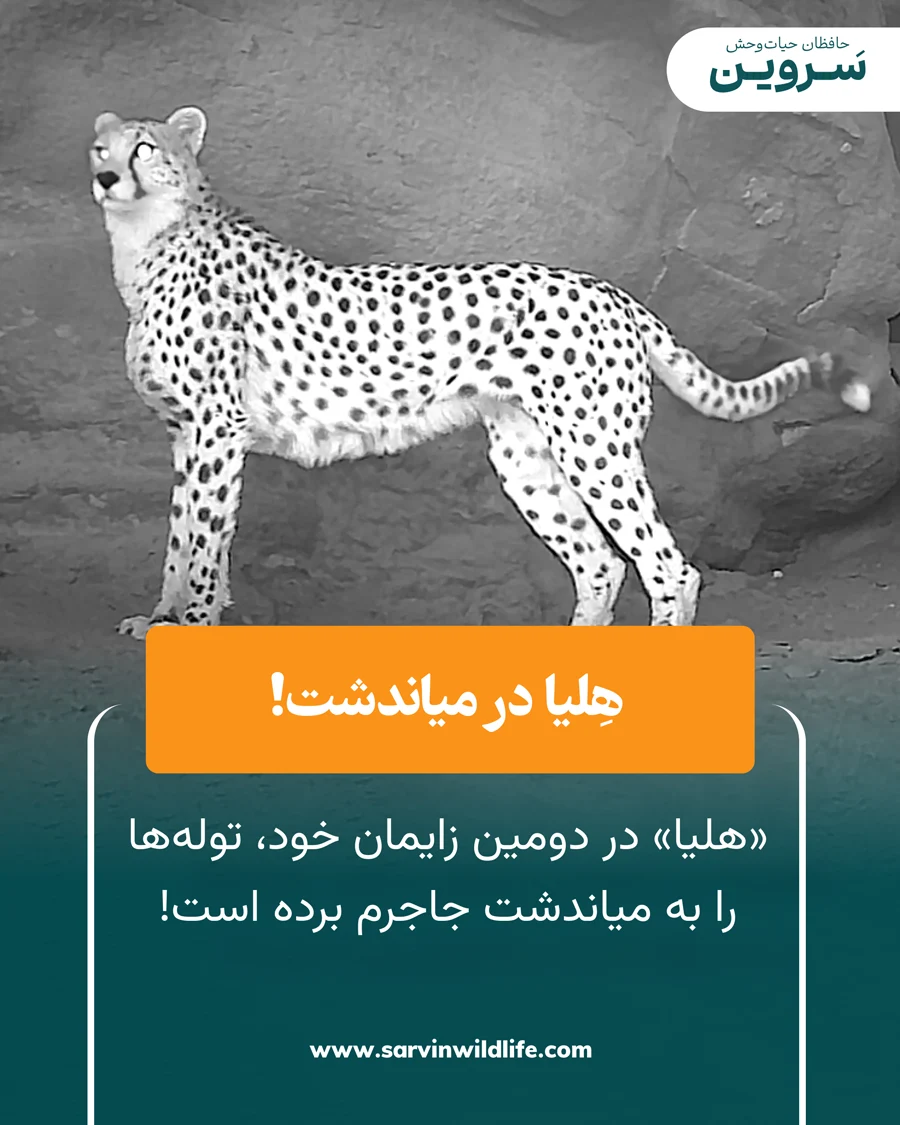
In December of this year, after six years, the Asiatic cheetah was once again recorded in the Miandasht Wildlife Refuge. The cheetahs that had been recorded previously were not identifiable due to the considerable distance, but the image captured five days ago by the camera traps of the North Khorasan Environmental Department revealed that this cheetah, a mother, is Helia. Unfortunately, her two cubs, born this year, are not visible in the image, likely because they did not come in front of the camera with their mother.
A week before this image was recorded, three cheetahs (a mother and two cubs) were spotted outside of Miandasht, and with the help of park rangers, volunteers, and locals, the risk of them being involved in a collision was avoided. The image of Helia reinforces the assumption that this is the same family and, fortunately, they have returned to the safe zone of Miandasht.
Helia is a five-year-old female cheetah born in 2019. She is the daughter of Herb, a successful and older female cheetah from the Turan Biosphere Reserve, and this is her second time becoming a mother. Last year, she lost her male cub to a road accident but was able to give birth to two more cubs this year.
The furthest point where we recorded Helia was in 2021, when she was with her two cubs in the Turan Wildlife Refuge, located about 132 kilometers away from her current location in the heart of the Miandasht Wildlife Refuge in North Khorasan Province. This remarkable movement of cheetahs is unique to the Asiatic subspecies, and it makes their conservation in Iran’s central deserts much more challenging.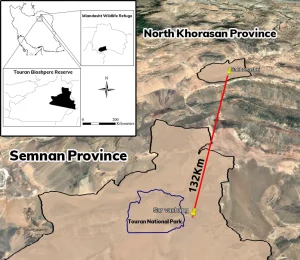
Helia has once again shown us how far cheetahs can move beyond our expectations. Installing satellite trackers has become an essential part of conservation today, as it is the only way to better understand these movement patterns. To conserve the few remaining cheetahs, we certainly need information that goes beyond mere guesses and assumptions.
We hope that Helia’s return to Miandasht signifies the selection of this habitat to raise her cubs and establish a new population in this favorable region.
As always, we are deeply grateful to the director of the Jajarm County and all the dedicated rangers in the area, whose love for cheetah conservation has made the region hospitable for the return of this species. We also appreciate the continued support of the Director-General of North Khorasan Province.
Leave a Reply